
Japan 24–7 Kazakhstan: Japan Takes the Top Spot in Asia
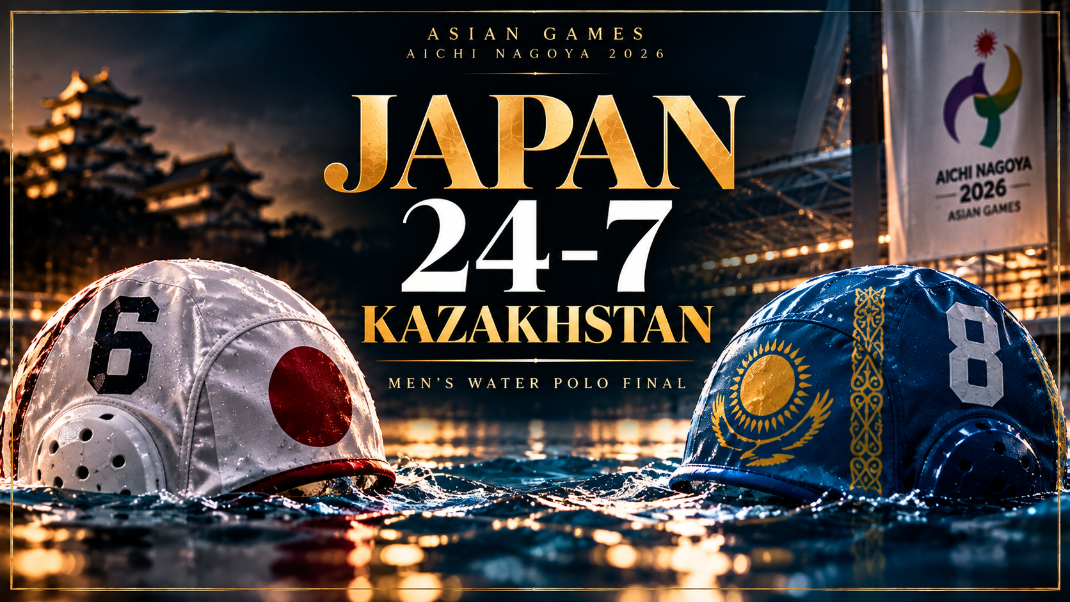
Japan claimed men’s water polo gold at the Aichi Nagoya 2026 Asian Games with a 24–7 victory over Kazakhstan in the final. Six games, six wins and a sixth Asian Games title for the host nation.
Japan 24–7 Kazakhstan: Japan Takes the Top Spot in Asia
Japan claimed men’s water polo gold at the Aichi Nagoya 2026 Asian Games, completing its tournament with an emphatic 24–7 victory over Kazakhstan in a final that began to move decisively in the host nation’s direction from the opening minutes.
Japan is back on top.
In the men’s water polo final at the 20th Asian Games, Aichi Nagoya 2026, the host nation defeated Kazakhstan 24–7 to claim gold.
The final score is emphatic.
The way Japan built it was even more striking.
5–0 from the opening quarter
Japan never allowed the gold medal game to settle into an even contest.
The opening period finished 5–0.
Then came an 8–2 second quarter.
At halftime, the scoreboard read:
Japan 13–2 Kazakhstan.
In two quarters, Japan had created an 11 goal advantage in an Asian Games final.
No way back
Kazakhstan did not score its first goal until Japan had already established a 9–0 lead.
Mikhail Ruday finally broke through and went on to score Kazakhstan’s next three goals as well.
But the gap had already become substantial.
Japan won the third period 5–2.
Another 6–3 followed in the fourth.
5–0 | 8–2 | 5–2 | 6–3
Final: Japan 24–7 Kazakhstan.
Two meetings, two clear victories
This was not the first meeting between Japan and Kazakhstan at Aichi Nagoya 2026.
They were drawn together in Group A and met in their opening match on September 26.
Japan won that one too.
19–11.
Yusuke Watanabe scored six goals in that first meeting, while captain Yusuke Inaba added three.
Seven days later, they met again.
This time with Asian Games gold at stake.
And the margin became even larger.
Japan’s road to gold
Japan’s run through the tournament extended far beyond the final.
In the preliminary round:
Japan 19–11 Kazakhstan
Japan 30–4 Thailand
Japan 30–6 Hong Kong, China
Quarterfinal:
Japan 32–8 Singapore
Semifinal:
Japan 26–12 Iran
Final:
Japan 24–7 Kazakhstan
Six games.
Six victories.
The 26–12 warning before the final
There had already been a clear indication of Japan’s form in the semifinal.
Against Iran, Japan raced to a 7–1 first quarter and a 13–4 halftime advantage before completing a 26–12 victory.
Daichi Ogihara scored seven times in that semifinal, while captain Yusuke Inaba added four.
Japan repeatedly created opportunities through pace, transition and attacks before the opposing defense could fully organise.
In the final, that approach contributed to an even wider margin.
A sixth Asian Games title
The victory in Aichi Nagoya gave Japan its sixth men’s water polo Asian Games title.
Kazakhstan, meanwhile, collected the first Asian Games silver medal in its history.
That context matters.
Kazakhstan is not a minor name in the history of Asian men’s water polo.
It has also won the Asian Games six times: 1994, 1998, 2002, 2010, 2014 and 2018.
Japan’s 24–7 victory therefore came against a national team with an established record of success in this competition.
Japan and the bigger picture
There is a wider story behind this result.
Japan’s development did not begin in Aichi Nagoya.
At the Paris 2024 Olympic Games, Japan recorded its first Olympic victory over Australia.
The team did not reach the quarterfinals, but its campaign included two one goal defeats, while Yusuke Inaba finished the preliminary stage as its leading scorer.
Two years later, Japan returned to Asian competition on home soil.
This time, there was no uncertainty about who took the gold.
19–11 in the first meeting. 24–7 when gold was on the line.
The podium
Gold | Japan
Silver | Kazakhstan
Bronze | China
China completed the podium with a 13–9 victory over Iran in the bronze medal game.
What comes after 24–7?
The Aichi Nagoya result tells us clearly which team dominated this tournament.
By itself, it does not establish where Japan currently stands against the leading powers of global water polo.
That requires different opponents and different competitions.
But within this Asian Games tournament, the conclusion is straightforward.
Japan 24–7 Kazakhstan.
Six games.
Six wins.
And gold stayed in Japan.